Wednesday, July 22, 2009

HISTORICAL AND ARTISTIC STYLES


Rococo Era

Rococo Era is expressed through out this dress by the low revealing neckline and embellishments on the front.

Designed by Forisbella.


Renaissance Era

(purple dress in the middle)


Even though this dress is much shorter then any of gowns of that time it still represents this era. It is shown through draping of the fabric through out the dress and over the shoulder.


Designed by Givenchy.


Romantic Era

(Pink dress)
This era stood out to me with this dress because of the sleeves. Very similar to the "leg of mutton" sleeves.

Designed by Dior.


Baroque Era

These dresses represent this era through their extravagant silhouettes. Another thing this era had was high waistlines which is shown with the dress on the right.

Designs by Dior


NEOCLASSIC ERA

This dress represents this era through its empire waist and layering fabrics. Through out this era it was mostly sheer fabrics that were layered but in this dress they had the layers tucked under and revealed in the front only.

Designed by Balenciaga


Gothic Era

"Dark tones translated the opacity of the tinted glass of stained- glass windows" This dress represented the Gothic era because of the black satin like material and unique look.

Designed by Chanel

Wednesday, July 15, 2009

GENEALOGY OF A HANDBAG

"Handbags have historically been both the carriers of secrets and the signifiers of power, status, and beauty. As the keepers of the equipment of daily life, handbags have been strongly influenced by technological and societal changes, such as the development of money, jewelry, transportation, cosmetics, smoking, cell phones, and the role of women in society."

Quoted from the random history website


This handbag is known as a girdle pouch. Both Men and Women wore these pouches in the 14th and 15th century. In this time the length of the chord on the purse related to the lifestyle of the person wearing it.


In the 16th century handbags became very practical with the products used to designed these bags. Most of the handbags were made from leather and some type of drawstring closer on top.


In the 17th century a lot more creativity was expressed through handbags. At this time embroidery and complex shapes of handbags became the main focus. Many women also used this as an opportunity to show that they we be good for marriage.

In the 1900's we began to use different textiles and objects to create new looks. This bag is from the early 1900's. The complete bag is made out of bamboo and rattan.

Moving on to today's handbags!! We are still progressing with trying to think outside of the box when it comes to design. However it seems that what is in style right now is simply designer. I see a lot of women spending a lot of money on a bag just simply for the name. I will say some of them are worth it but some are simply over priced! Its amazing that even today a different bag represents a person in a different way.


Wednesday, July 1, 2009

Historical Garments (Draped/Tailored)
My First draped garment that I wanted to share is shown on this statue. This statue in of Pallas Athena velletri. This dress has brought out a lot of layers around the waist and gives a draping affect. It almost seems like most of the outfit is just laid on her and has a simple belt for the waist.

I know I already showed a Greek goddess but I felt that this statue had a very unique look as well. This is the statue of Eirene, also know as the goddess of peace. The other dress had more draping towards the bottom and this one seems to have more of the activity in the top portion.


This picture is done by Edward Lane from his "description of Egypt". This picture is a great visual for draping it shows how they really just let the material hAdd Imageang. Even with the belt it doesn't have a fit look to it.


Now when it comes to the tailored look I decided to show the Washington family. George and Martha both have a very fit and tailored look. The mens outfits at this time were very form fitting with even a vest underneath the tailored jackets. Martha on the other had a fitted dress from the waistline up. In this time they still wore the voluminous skirt with a corset like top.

This image is of Queen Victoria. I felt she was good visual for a tailored dress due to the corset top. Very similar to Martha Washington but almost a hundred years apart.


My last visual is of the one and only Coco Chanel. Coca is well know very her tailored suits. This picture is from the early 1900's and still the tailored suits continue to be very popular.


Thursday, June 25, 2009

GROUP MEMBERSHIP


An African tribe
This picture was taken by Trevor Cole

Their paint, hair, and body piercings are the way that this tribe shows who they are.

ENVIRONMENTAL PROTECTION


This is a picture from the movie Indiana Jones, notice the light linen shirt and durable khakis along with a thick brim hat to protect him from the sun.

DECORATION


A lot of decoration is show through out the world by tattooing of the body with different artwork.


GENDER DIFFERENTIATION


CEREMONIALISM


I found this picture of a Bar Mitzvah taking place. I am not Jewish so I am not sure about what the garments mean but I believe their a must for the ceremony.

SEXUAL ENHANCEMENT


And for sexual enhancement I felt I needed to put the late Farrah Fawcett from her sex icon days (1976).

Saturday, June 20, 2009


EMPIRE LINE DRESS
Early 1800Add Image


The fabric for these dresses were usually a fine white lawn, muslin or batiste. In the winter heavier velvets, cottons, linens, fine wools and silks were used to make them warmer.


Early Brassières

Most designers have tried to claim that they designed the first bra but most of them just promoted a breast retaining garment do help with certain outfits. The first bra was patented in 1914 by Mary Phelps-Jacob under the patent name Caresse Crosby. The very first one consisted of silk handkerchiefs tied together with baby ribbon sewn on to make straps and a seam set in the center front.


Cloche Hat 1920's

The cloche hat is a fitted bell shaped hat.
Designed by: Caroline Reboux

These hats are mostly designed in felt so they are able to form to the head. Women would also apply a ribbon to them a certain way to help define their marital status.


Cross Cut Bias Method (1920's)

Designer: Madeleine Vionnet

Using Madeleine's techniques designers were able to produce magnificent gowns in satins, silks, chiffons, crepe-de-chines, and crepes.


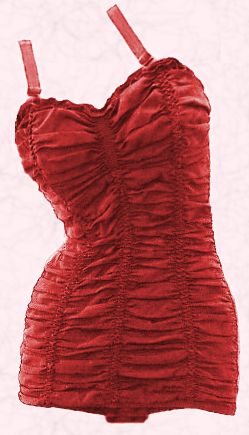
Elasticated ruched swimsuit c1955.


Apron Style Swimsuits
1950's

Each of the bathing suits had detachable straps, these suits are equivalent to a beach corset. They used all types of fabrics including lined cotton, stretch Lastex and elastic ruched waffle nylon.


This photo is from fashion week 08'
These are the 1980's inspired fashion by Betsey Johnson, Marc by Marc Jacobs and Preen

I chose this photo because you can see a lot of the trends from the eighties. This is when the Lycra mini skirts were worn as well as the tight almost spandex like leggings. The oversized sweaters came in many different fabrics including cotton and cashmere.


Designers going Green

This picture is of one of the models from Dehli's fashion week. This year their theme was going green. Nitin Bal Chauhan used handwoven wool from shepherds in Himachal radesh. Samant used natural silks and recycled junk jewelry. Ruchira Kandhari and Ekta Jaipuria combined orgnaic knits with vanya silks sourced from the north-east.

Tuesday, June 16, 2009

First and foremost thank you for stopping by my page. I am looking forward to sharing my thoughts, inspirations, and visions through out this semester. I am always interested in feedback so please don't hesitate. I have never blogged before so this is a new experience for me.